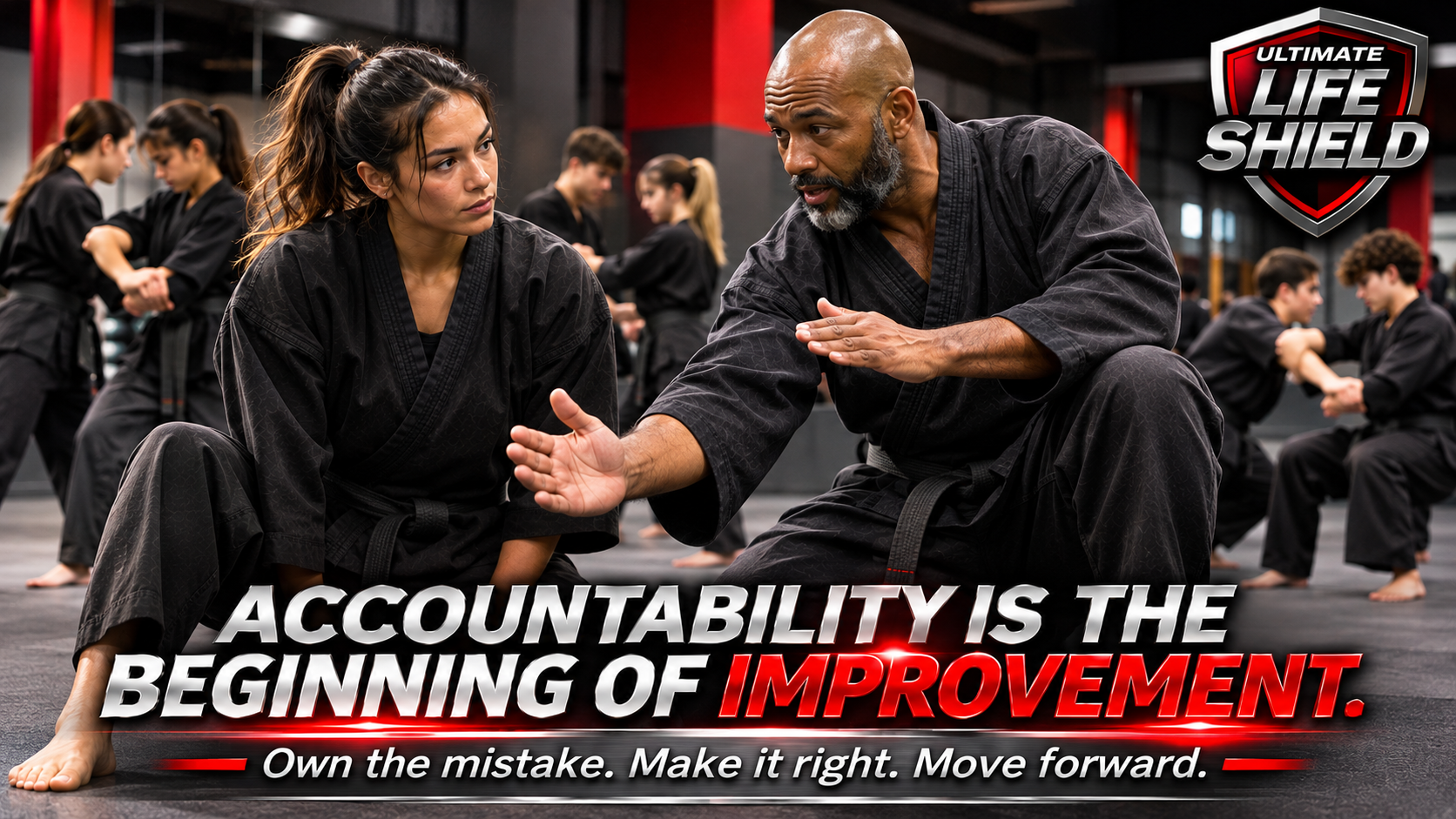
Why Taking Responsibility Is More Powerful Than Making Excuses
Why Taking Responsibility Is More Powerful Than Making Excuses
Nobody enjoys admitting they were wrong.
It's uncomfortable.
Sometimes embarrassing.
And occasionally it requires a conversation we'd rather avoid.
But here's something worth considering:
The ability to acknowledge a mistake may be more valuable than the ability to avoid one.
Because no matter how careful, experienced, or intelligent we become, mistakes will happen.
Parents make mistakes.
Teachers make mistakes.
Managers make mistakes.
Martial arts instructors and students make mistakes.
What separates responsible behavior from irresponsible behavior isn't perfection.
It's what happens afterward.
Consider two responses to a missed commitment.
The first:
“I was busy. You should have reminded me.”
The second:
“I forgot. I'm sorry. I'll take care of it, and next time I'll set a reminder.”
Both people missed the commitment.
Only one is actively addressing the problem.
That's accountability.
And it's an important lesson for children because we sometimes unintentionally teach them to fear mistakes more than dishonesty.
If every mistake becomes a major confrontation, children may become more focused on avoiding consequences than learning from their decisions.
A healthier approach is to make accountability constructive.
What happened?
What was the impact?
How can we repair it?
What should change next time?
This doesn't eliminate appropriate consequences. It gives those consequences a meaningful purpose.
In Hapkido, students experience correction constantly.
A technique doesn't work.
Their balance is incorrect.
They forget part of a sequence.
The instructor provides feedback.
The student makes an adjustment.
Then they try again.
We don't want students believing every mistake is a personal failure.
We want them understanding that correction is part of improvement.
The same principle applies to relationships.
An apology can begin the repair process, but it doesn't automatically restore trust.
Sometimes we need to replace something, finish a task, change a habit, or demonstrate better behavior over time.
For adults, this lesson can be especially meaningful.
Imagine the example we set when we tell our children:
“I was wrong. I shouldn't have handled that situation the way I did. I'm going to work on it.”
That's not surrendering authority.
It's demonstrating accountability.
This week, when you make a mistake, resist the temptation to immediately defend yourself.
Acknowledge what happened.
Consider its impact.
Then ask:
“What would making this right look like?”
That's responsibility in action.
❤️Scott Yates & Team Ultimate
Ultimate Martial Arts & Kickboxing
31 Years of Community Service
Grab our FREE Kids Confidence Guide Here:
https://info.atcomartialarts.com/ultimate-back-to-school-success-guide-420704
More Blog Articles Here:
https://info.atcomartialarts.com/ultimate_blog
Speak with an Ultimate Instructor about our Self Protection Program:
https://api.leadconnectorhq.com/widget/booking/jrVx7dmqRI8W2aW5mdrk
